Monday, March 26, 2007

Perils of Statistics in India: A tale of Rhino Park in Hooghly district

The Day Hooghly Almost Got a Rhino National Park

A journalist friend — fresh from a detour through Calcutta on his way to Nandigram (Hooghly district) — told me a story that’s too good not to share. Nandigram is the place where forced land acquisition turned into a very public headache for the ruling party. But this tale isn’t about politics so much as about that other dangerous thing: statistics with imagination.

As a student of statistics I pride myself on the subject. And yet I cannot help remembering that immortal line: “Lies, damned lies, and statistics.” This is, without doubt, the funniest statistics-related disaster I’ve heard.

Here’s how it went. A forest officer in Hooghly received a letter from the state capital asking him to draft a proposal for a National Park — specifically for rhinos. The letter quoted a reputable national wildlife report that listed Hooghly as having about twelve rhinos. Twelve rhinos. In Hooghly.

The officer blinked. He’d never seen a rhino on his morning rounds, or in any convincing local lore. Curious (and slightly alarmed), he asked for a copy of the report. He checked with locals. No rhino. No one even had a rhino-shaped shadow to report. He sent the query back up the chain, and an investigation began into how a respected survey could conjure a dozen rhinos out of thin air.

The answer was deliciously mundane.

We Indians have a well-known affection for the language of empire: English. Not always used correctly, but always used as evidence of education. The national livestock statistics reach the capital via questionnaires sent to every panchayat, and those questionnaires are filled out by low-level village functionaries. One such conscientious babu in Hooghly dutifully recorded the village livestock: ducks, geese, and — importantly — gander (the male goose).

At the state headquarters, another babu — busy, patriotic, and not exactly a lexicographer — compiled entries from many villages. He scrolled through towns that reported “ganders.” One panchayat showed a number under “gander.” Unfamiliar with the English term, our heroic compiler read it through the lens of Bengali: “gondar” — which, conveniently for the plot — is the Bangla word for rhino.

A tiny spelling/translation hiccup later, and voilà: twelve rhinos were officially living in Hooghly. No one bothered to cross-check. The table was printed in a national report. High officials, seeing “twelve rhinos,” promptly decided — with all the decisiveness of government — that Hooghly needed a rhino national park.

So here’s the moral for devotees of data: do not place blind faith in statistics — even when they come from “reputable” sources with glossy covers. Always ask what the numbers don’t say. And for goodness’ sake, don’t let a single mistranslated “gander” set your conservation agenda. Otherwise, India may be dotted with rhino sanctuaries in places that, until yesterday, only hosted overenthusiastic geese.

Common sense, it turns out, is still the best quality-control department — and usually cheaper than building a national park..
Thursday, March 1, 2007

Growing Up with Amar Chitra Katha

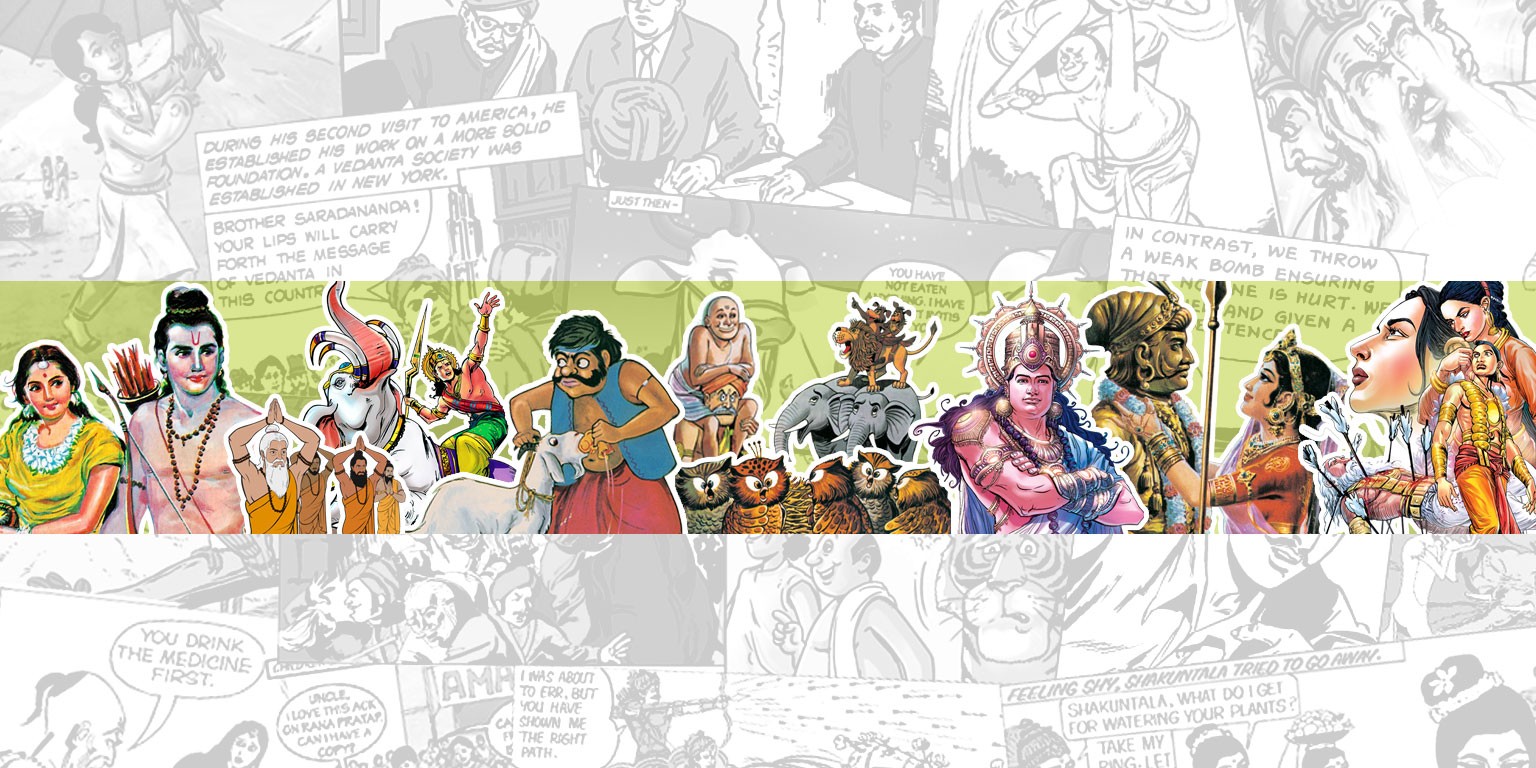
Image result for amar chitra katha collage

I love comics. They are a healthy mix of two good things of life: pictures and stories. Moreover , they are crisp and short. You can take them in a train journey, to a friend's place and  even smuggle them in a schoolbag. As a child I had a privilege of having two very sensible elder sisters who treasured their comics like jewels and later, passed on the legacy to me- the youngest of the trio. I can recall those happy days like it was yesterday, when I will spent entire hot afternoon of Indian summer, deeply engrossed  in the stories of kings and queens, Puranas and Jatakas,  folk tales, stories of  thieves and pirates, Panchtantra and occasionally Phantom, Mandrake too. Oh ! those blissful days. 

My sisters used to ‘issue’ me comics for a limited time with all kinds of instructions of not folding them , no dog ears and no reading while eating . (At times I violated the last one when they were not around). Each comic was had a specific place in a particular stack according to its subject and of course ownership, (divided between my sisters). We were very proud of our collection of about 400 comics which was considerably more than that of any friend …and extreme care was taken to increase this collection at any possible opportunity viz visit of an uncle/aunt, birthdays, gain of some pocket money etc. Though we used to read all kinds of comics, our parents specially encouraged us to read Amar Chitra Katha. As a child I was not aware of the logic behind this preference but later in life, I really thanked them for being so careful of what their kids were reading. Today, I do not miss Tintin or Asterix, Phantom or Flash Gordon as much as I miss my days with various titles of Amar Chitra Katha. These storybooks were a real treat for a young person in my situation.
                Image result for amar chitra katha collage

I gratefully acknowledge the role of Amar Chitra Katha in forming my opinions on a variety of subjects. It was through them that I was introduced to most of the Sanskrit classics, folk tales of various regions, myths and historical characters. I still have that collection intact at my parent’s house and I refuse to part with it unless I find some worthy inheritor. In fact when my niece was growing up I used to take out these comics for her during her vacations and never missed to refresh my memory with another read. I am sure the same fondness is shared by many in my generation.

The amazing story of Amar Chitra Katha started in 1967-68 when an attempt to translate the myriad tales from Indian history and culture into comics was made to cover a wide spectrum of titles. It was the creative genius and foresight of the legendary editor, Anant Pai and the entrepreneurial zeal and courage of the publisher G.L. Mirchandani, Chairman of India Book House that give birth to a brand which delighted generations of children(and their parents) since then.

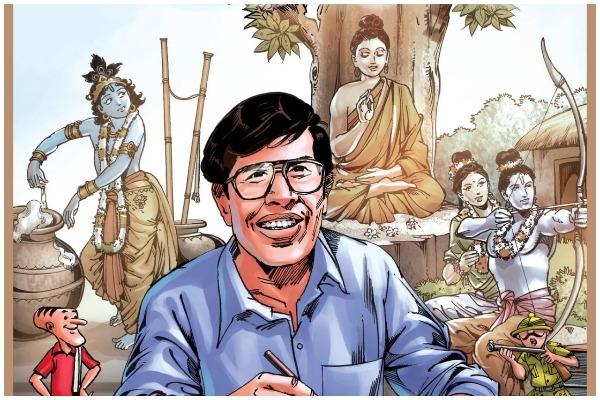
Image result for anant pai uncle

It is said that one day as he was watching a quiz programme on television; Anant Pai saw that the participating children from English-medium schools were well versed with the lore of Tarzan and the exploits of Greek gods but could not answer simple questions about the Ramayana. That is when he decided to use the popular medium of comics to acquaint Indian children with their rich cultural heritage. And god bless that decision! I passed many history exams in my childhood thanks to Amar Chitra Katha. I still remember that as a student of class 3, I was the only one who could give the entire list of Mughal kings in a school quiz. That was easy, for I had read about all those emperors in Amar Chitra Katha and my disciplined sisters used to keep the comics on historical characters in the strict order of history.
Through the medium of comics, Amar Chitra Katha brought to life the colourful mythologies and legends of India. The Route to your Roots was the catch phrase coined to describe the efforts of Amar Chitra Katha to tell tales of heroes and heroines from Indian mythology, history and folklore.

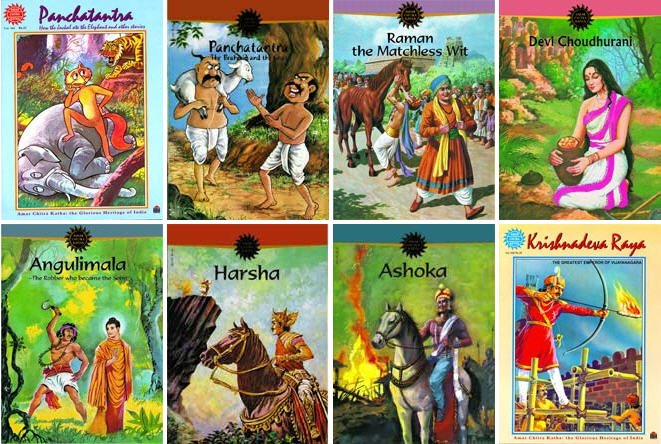
              Image result for amar chitra katha

These comics enriched my storehouse of stories manifold. I still feel that my knowledge of folk tales, tales from Buddhist Jatakas, Jainism, Panchtantra, classics of various Indian languages and Hindu myths is much more than most others. All thanks to Amar Chitra Katha which made me associate each story with beautiful illustrations and well chosen dialogues. Later in life when I read the original stories/books , the images from comics were still in my mind. Best part about these comics was their factual correctness.
According to the strict editorial policy, each detail had to be culled from a reputed reference and had to be available for any query, because Amar Chitra Katha, by the 1980s was taken as an authentic secondary source of information. I feel sad that Anant Pai’s contribution in heralding this cultural information revolution still lacks proper acknowledgement in terms of civilian honours like Padma Bhushan .
But who cared for these details as a child. For me , they were interesting tales of princesses and kings, sadhus and reformers , a poor orphan girl in Patliputra or a farmer in King Harsha's kingdom. And all together, it was a world of wonder , magic and colours. Today , I feel very happy to find AMAR CHITRA KATHA back in the bookstores after a gap. Also a good database of the titles is available on their website . For me finding these books on a bookshelf  today , is like meeting childhood friends…. a taste of good memories of happy days.