Thursday, March 19, 2020

Garden Diaries: March ( A season passes by )


A time to be born, and a time to die; a time to plant, and a time to pluck up that which is planted;
Ecclesiastes 3:2
On 5th March, my garden was on full bloom. Sun was shining bright and birds were chirping as usual. When I went home for lunch around 2 PM, I happily checked my flowers and my seedlings (sunflower and zinnia) and even took some photos of Delphiniums, Larkspurs, Nasturtiums and Cineraria.
Hailstorm
Around 4 PM, there was a sudden hailstorm……. the lawn turned white and the flowering plants were slayed within minutes. Hailstones of the size of golf ball were too much for my delicate flowers to bear. At the end of it Nasturtiums, cinerarias and Petunias were gone completely. Few pots and flower beds in shade of trees survived the worst.  Kalnchoes and Impatiens suffered major damage and in short, the garden was ruined. It was a sad sight and it broke my heart.

Orange blossoms
Next morning, the sun was back, so were the birds and while I was still mourning the destruction of yesterday, nature had started building up. The geraniums started showing new buds in few days and even the petite pansies fought back. The water in waterlily tubs had turned black but soon, I saw new leaves of waterlilies too. The calendulas and Helichrysum braved the damage and again stood tall.


 I was still sad thinking of the premature ruin of my pretty flowers. Then on a Saturday, standing out in bright sun I saw a blue sunbird happily frolicking among the larkspurs. It was such a heart-warming sight. Standing in the middle of ruined flowerbeds, I smiled.

Since then, slowly but surely things have warmed up in the garden. Nastratiums are now replaced by the tiny seedlings of Zinnia and in place of my pretty pink petunias, I have planted Giant Russian Sunflowers. Gaillardia and Vinca will be next and of course Kochia and Portulaca. It is said that “A good gardener always plants 3 seeds -one for the bugs, one for the weather and one for himself.” But well, I did not. Hailstorm also killed many of the seedlings. The mis-calculation has costed me one full month. At present I have vacant flower beds but nothing to plant. My Mixed Zinnia seeds are coming up slowly and hopefully in another 20 days I will be all set to face the summer with my summer flower garden.
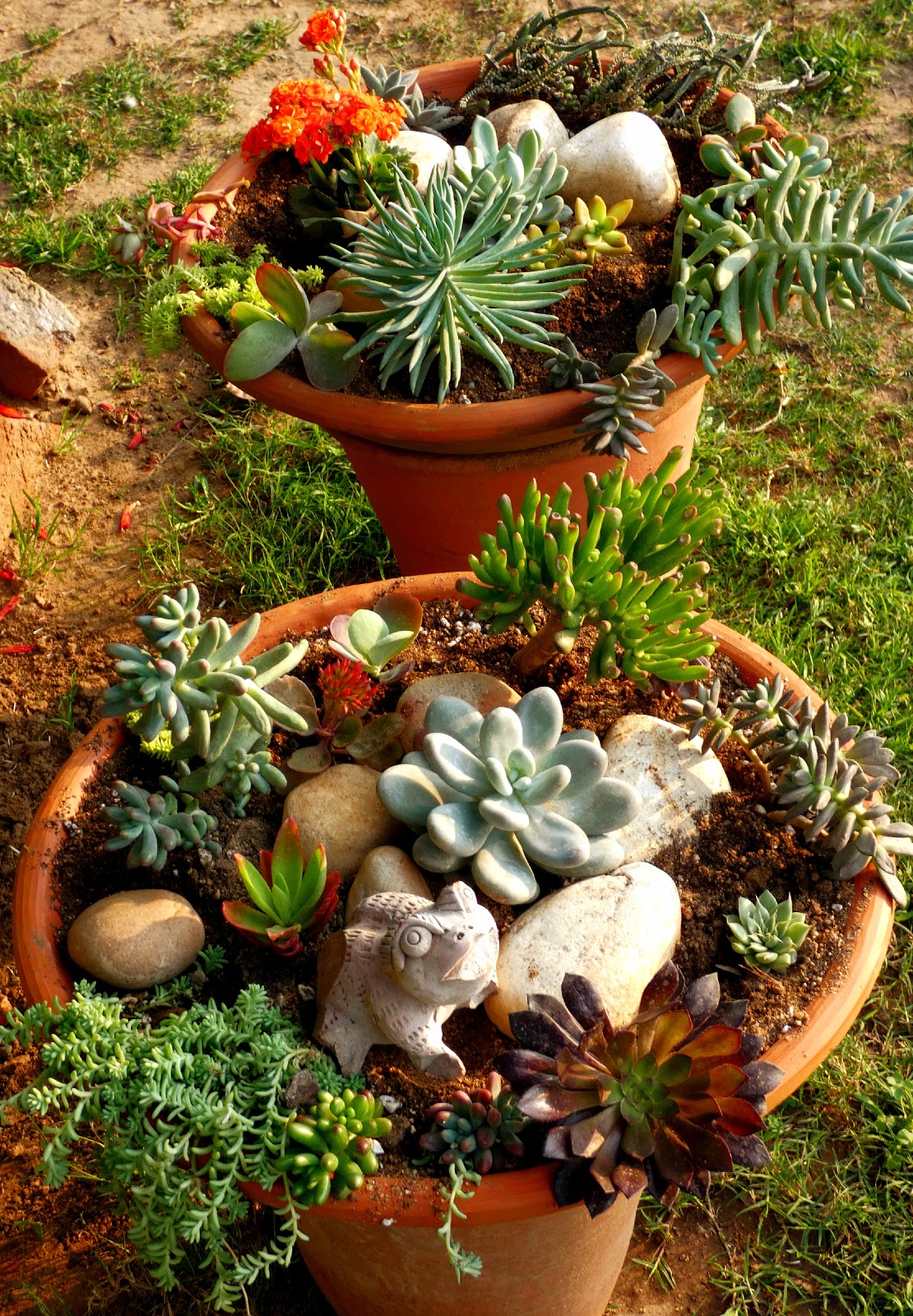
Trays of Succulents 
Meanwhile, I had collected some succulents and had arranged two trays of them. They also suffered some damage in the storm but these tiny plants are known for their sturdiness. So they are doing fine. I am still not too enchanted by them as I find flowers much more delightful. But who knows? I also got some more succulents as gift and may be another arrangement will soon follow.
Helichrysum- the everlasting flowers
To see a world in a grain of sand and heaven in a wild flower Hold infinity in the palm of your hand and eternity in an hour.

                                                                                       -- William Blake
That is funny part of being a gardener. Your garden often knows better than your imagination and skill. The storm had damaged one part of mango blossom also and yet the other side of this good old tree is still  a sight to behold – full of pale yellow blossoms. As I have always believed – Mango blossom is the true portent of summer. So here it is – the summer of 2020.
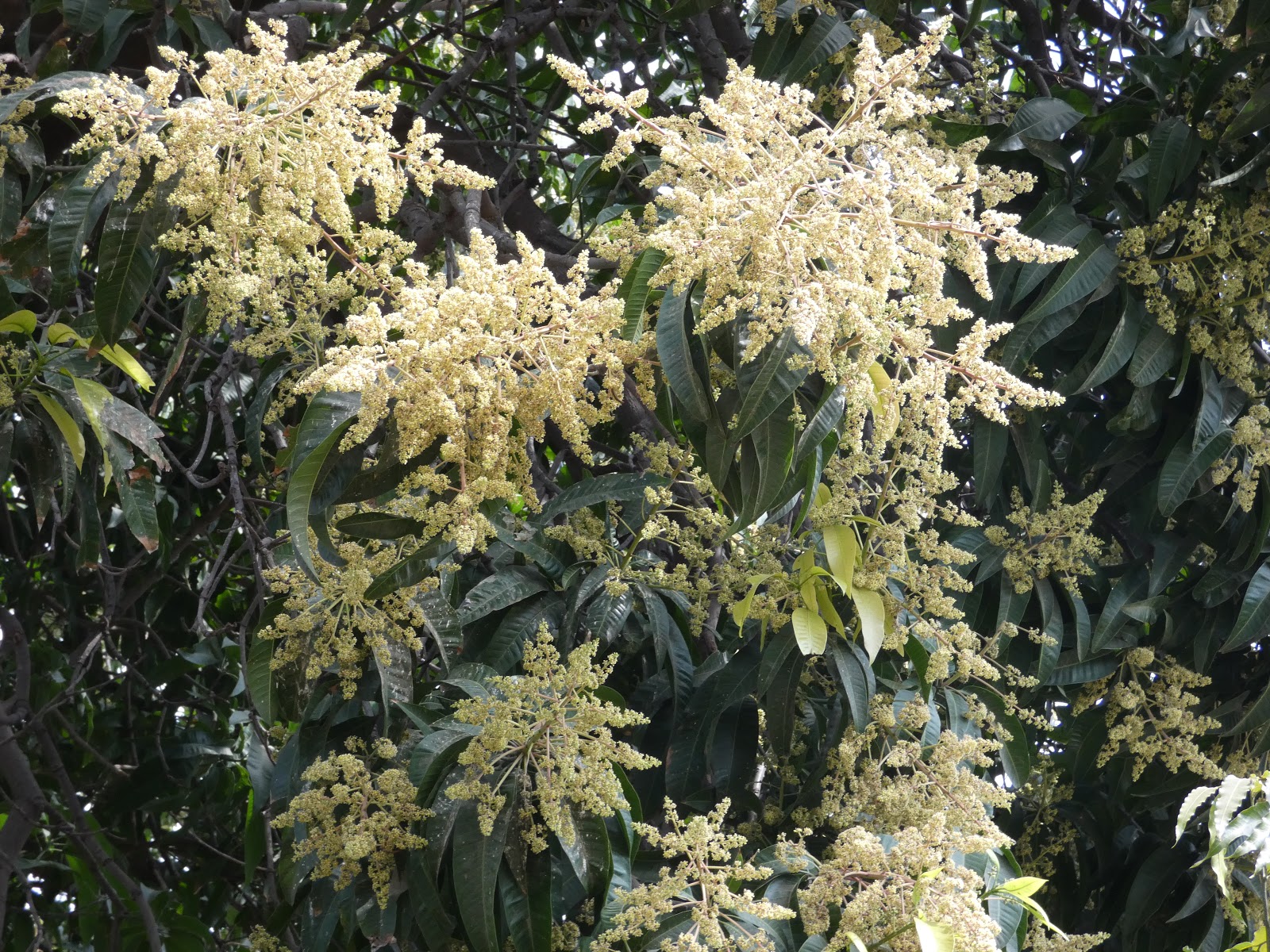

Outside the limited world of my garden, there is a real scare of an epidemic. The virus is spreading world over and the normal life has been shut down in so many countries. For the first time the scorching summer sounds very welcoming. Temperature in the city is touching 32 and hopefully, we won't be affected much with the deadly virus thanks to the heat.

I just remembered that this is the 12th edition of my garden diaries. It was fun writing these posts. I do hope I will read them in future and remember the joy my garden brought me whole year through. It was a great learning for me as gardener and also as a person. I learnt the lesson of patience and moderation, a lesson of learning the skill right and most of all, I learnt that it takes a dallopful of faith and trust in nature for a garden to bloom. I am ever so grateful that I could hear the music of the earth and could hum its tune this whole year through.

Thursday, February 13, 2020

Garden Diaries: February (It’s springtime)


"Was it the smile of early spring
That made my bosom glow?
'Twas sweet, but neither sun nor wind
Could raise my spirit so.

Was it some feeling of delight,
All vague and undefined?
No, 'twas a rapture deep and strong,
Expanding in the mind!"

-  Anne Bronte, In Memory of a Happy Day in February

Spring has officially arrived in my garden. Flowerbeds are bursting with colours, birds are chirping, sunshine is bright and golden and the breeze is fresh and welcoming. I can spend all my waking hours in my garden and not get tired. There are so many kinds of flowers around that I often lose count of them.It has always been an issue with me whether to plant a single flower in a bed or have a mix of 3-4 kinds of flowers. This year I have gone for mixing...mostly . The result is not too bad. Well, there is only a finite number of plants one can have in a garden and however big is the garden - it is always a dilemma to choose the best place for each variety . I am sure I have about 20 kinds of flowers blooming right now in the garden. 


 So let me try to list them – Impatiens, Salvia, Petunia,Begonia,English daisies, Buttercups, Primroses, Mimulus , Kalanchoes, Gazania, Dahlias Pentas , Nasturtiums, Geraniums, Verbena, Pansy, Dianthus, Larkspur, Cosmos, Marigold, Calendula and  Roses . Next in line are Cineraria and Sweet peas.

Pretty buttercups
But the thing with gardening is that there is always so much to do. Chrysanthemums are almost over and need to be saved for next year. There is always need to cut worn out blooms and clean the flowerbeds. With dozens of squirrels around (who love to eat my French marigolds), there is always so much action in the garden. They chase the birds and cut out all leaves and wires.


Sitting in my garden during weekends, I cannot help feeling grateful. It is such a marvel that nature expresses itself in so many colours and patterns. Just to give an example of Larkspurs, the tall and graceful flowers – they stand out because of their blue-purple colour and their graceful waving in the wind. Then there is verbena, tiny small groups of flowers, they come in all possible colours and can melt even the most stoic hearts. Not only flowers, the variety of birds I see daily in my garden is pretty amazing too.
Some birds sighted in Bharatpur

Talking of birds, in late last month I went to Kaleodeo Birds Sanctuary at Bharatpur. I will be honest; I had never seen so many birds at one places ever before. Gosh! What variety of birds it was! From tiny Siberian blue throat to huge painted storks, from owls to vultures, from kingfishers to greater pelicans   - it was an actual carnival of birds.  Even the place where we stayed (Bagh Resort) was full of ducks, peacocks and all kinds of birds.

 Every spring
I hear the thrush singing
in the glowing woods
he is only passing through.

His voice is deep,

then he lifts it until it seems

to fall from the sky.
I am thrilled.
I am grateful.

― Mary Oliver


Back home, our spotted owlets’ family continue to sunbath in the mornings, two young peacocks knock the glass doors very often in afternoons and groups of jungle babblers, magpie robins and brahminy starlings hop around the garden. As for noise, no one can beat the parakeets who make it their business to make their presence felt.  A pair of koels are nesting in a neem tree in my house and I often spot grey hornbills on the same tree as well.

By the way, the honeybees deserted the other beehive also soon after I wrote my last post. While I see plenty of honeybees collecting honey from cosmos and marigolds, I have no idea where their new hive is located. I would like to have more butterflies around and I do hope they will get lured by the flowers.

  Amidst all this, like an anxious gardener I am dealing with the dilemma of whether I should start planning for Zinnias, sunflowers and Mexican cosmos right now or wait for few more days. Learning from my experience at the beginning of winter, I think I will wait for some more time. Though it is true that spring won't last very long and even before we know, the days will start burning and the summer will arrive .  I have always felt grateful that I live in a country where each season is so beautiful and the change of seasons is full of so much anticipation and excitement . It is inevitable that the seasons will change and the flowers will wither , but as for now, let me soak in the beauty of  my February flowers.
Larkspurs 
                                           “We need beauty because it makes us ache to be worthy of it.”
                                                                                 ― Mary Oliver

Friday, January 10, 2020

Garden Diaries: January Celebrations


“Which month shows our garden at its best? Each month we exchange old beauties for new ones. If we could have them all together, what a wealth of loveliness it would be. Since we cannot, which month shall we choose to throw a small party?”
                                                                                                   ~A.A.Milne
My answer to the question above is undoubtedly January. Well, I may not be a great fan of parties or socialising but I like this month. Somehow, in my mind, this is “my month”. Other than the fact that the month starts with my birthday – I kind of like it for what it represents. New beginnings, a celebration and lots of introspection for the year gone by and of course, eating. But more on that later.
Few days back I came across two Japanese words/ concepts which very deeply explain my feelings for my garden this month. 
Dahlia- the big and beautiful

The first was Mono-no-Aware (MOH-no no ah-WA-reh). Mono-no-aware says that beauty is subjective, and it’s our sensitivity to the world around us that makes it beautiful. In particular, the transience of the physical world and our awareness that beauty is impermanent makes us appreciate it more. It is considered that the epitome of mono-no-aware is the sight of cherry blossom petals falling in the springtime. I often look at my flowerbeds and think of their impermanence. 
A pink rose in different stages 
That kind of make me greedier in savouring it. Every morning when I step into my garden, I can’t help remembering that it won’t last forever. Sooner or later – I will leave this station, this office, this garden. It fills my heart with gratitude that I got to enjoy and savour so much beauty here. A true mono-no-aware sentiment.
Tiny pansies
The second concept is Oubaitori (oh-buy-toe-ree) – an idiom made from the characters for the four trees that flower in the springtime, cherry, plum, peach, and apricot, this means that people shouldn’t live their lives comparing themselves to others, but instead value their own unique traits- like the unique traits of the four spring trees. It is also so true for the gardens. While all gardeners compare and take pride in their gardens, it is actually quite meaningless. No two gardens are same – no two plants are same. Each has its own beauty. Just to cite an example, in colder countries I have seen very colourful and sturdy stock flowers. They are tall healthy sticks in unbelievable colours. In my own garden, my stocks are never so tall. It may have to do with climate or soil or even seeds……in comparison they may look petite, but I love them. They look so fresh and so welcoming.
My not-so-tall Stocks
"In my garden there is a large place for sentiment.  My garden of flowers is also my garden of thoughts and dreams.  The thoughts grow as freely as the flowers, and the dreams are as beautiful."    
                                                                                                                     -  Abram L. Urban
Garden provides one an ideal setting for introspection, for reflection and for getting nostalgic. How can I not feel nostalgic in January when the month starts with my birthday and ends with the day I lost my father 20 years back. Two decades is a long time and yet every time I look at my Cineraria plants I think of Papa, every day when I check on my sweet pea climbers, I remember him doing that years back. In those days we did not have so many hybrid seeds available as we have now. Also many foreign flowers have now made their way in Indian gardens. I am sure Papa would have  been delighted to have primroses, buttercups or purple salvias in his garden.  
Ranuculus- Buttercups
My garden in January is full of flowers- the newest entrants are stocks, buttercups, primroses, calendulas and lot more pink cosmos. Of course we are still waiting for the ice flowers, paper flowers and Larkspurs. The fun part is, you always enjoy the flowers which are difficult to grow and make you wait , much more than the easy ones. Even better are flowers that surprise you completely as you never knew they were coming. This month , suddenly one of my Cactus bloomed. I only found out later that it is called Christmas Cactus and it normally blooms around Christmas. Well, it bloomed in January and it was profuse flowering . It has beautiful pink flowers which make my heart dance every morning .

Christmas Cactus on Bloom 
 But then, a garden is not made just with flowers or grass. The other essential ingredients include sunshine, trees, birds, bugs  and bees. Yes, bees are important for any eco-system. For last year and half there was a huge beehive on a big tree, just opposite my gate and naturally many honeybees came to the garden. Late in December one day all of a sudden, I found that the bees have left the hive en-masse
An abandoned Beehive


The abandoned hive was there and two brave squirrels were licking the remaining honey out of it. It made me curious. On reading more about it I learnt that it is called absconding and it is a well-known behaviour pattern of bees. Absconding is when the bees completely abandon their hive. All or almost all of the bees leave the hive along with the queen. They may leave behind young bees, who cannot fly, unhatched brood and pollen. . 

I am not sure what was the reason here but luckily for my little eco-system, there is another beehive on the mango tree which is full of activity and is bursting with bees.

Much like flowers, even the kitchen garden is looking superb these days. The joy of plucking a cabbage from your garden and cooking it , has a pleasure of its own. Well, we also have Cauliflowers, Green garlic, Radishes, spinach, tomatoes and of course, gooseberries.
Cosmos
The last year in garden was an amazing learning. This year too seems so full of possibilities. Hope to grow many more new flowering plants and learn new tricks of gardening in coming months.  

Saturday, December 21, 2019

Garden Diaries: December (Winter in its glory)


I catch the sweetness of thy latest sigh...
Here in the dim light of a grey December
We part in smiles, and yet we met in tears;
Watching thy chilly dawn, I well remember...
Farewell, old year; we walk no more together;
~Sarah Doudney (1841–1926), "A Parting"

I was not ready for December, it kind of came too soon this year. November went flying – and just like that it was December. Well, I was not ready but finally my garden was ready to embrace the glory of winter. Misty mornings which makes you believe in life and all good things, followed by golden afternoons, which envelop plants and the creatures of the garden to turn them beautiful like never before. Yes, the short and sweet days of winter are here. Sunshine makes you feel loved and winter flowers make the landscape pretty. 


Kachnar flowers
We are essentially a summer country and we do not glorify winter all that much in India. But the fact is, Indian winter is also beautiful in its own ways- it is the time for many celebrations, travels, culinary delights of the season and of course the gardens showcase a riot of colours. When it comes to gardens in winter, it is easy to recall the seasonal winter flowers and winter vegetables. Surprisingly, the typical image of winter, in my mind is also made up of flowering trees. I would specifically mention three -  edible Kachnar blooming everywhere in the city and neighbourhood, silk floss tree- which made our Delhi campus pretty in winter months and a very useful drumstick tree. They are all flowering at present with purple-white, hot pink and white flowers respectively. 

But they were not what kept me occupied this month. It was tending to my flowerbeds of winter annuals that kept me busy.  I am now happy to see the result of all that endless planning and planting. 

    The crowning glory is of course chrysanthemums. It is now blooming all over in many colours, shapes and sizes. The Chrysanthemum, or Kiku in Japanese, is a symbol that represents longevity and rejuvenation. It is said that, when this flower was first introduced to Japan during the Nara period (710 – 793 AC), the Japanese Royal Family was fascinated with the Chrysanthemum. It started appearing in their crafts, dress designs and seals soon thereafter.   Eventually, the Chrysanthemum become the imperial family emblem and continues to be so. To this day in Japan there are two imperial garden parties given each year: that celebrating the cherry blossom and the formal rite of the chrysanthemum. 


Interestingly, in the second chapter of The Tale of Genji, the 11th Century Japanese classic, a remarkable reference is made to the revered chrysanthemum. At one place it says: "The chrysanthemums had turned very nicely, and the autumn leaves flitting by on the wind were really very pretty." The footnote explains that “Frost withered chrysanthemums were prized." How odd? One can perhaps understand another reference to chrysanthemum buds with beauty of a young woman, but withered chrysanthemums? And then recently, while admiring my partially withered flowerbed of Magenta Mums, it came to me that maturity has its own beauty- in people and in flowers. Once the joy and anxiety of growth has faded, it leads to contemplative deliberation, retirement and peace - all the qualities that contribute to patient and graceful endurance. My beautiful Mums, some gracefully past their prime and others just a bud, are a delight to my heart. No wonder in many eastern cultures, these flowers have inspired poetry, art and philosophy.   

Delicate Begonias
Other than the Mums, I have delicate begonias, colourful Dianthus, Asters, Impatiens and lovely Geraniums. Of course the Pansies are also on bloom but I know they will get better next month. Begonias have a succulent stem, designed for storing water which is used during the dry periods of the year. I like its small flower as well as ornamental foliage. But honestly, last year I did not have much success growing them. I am told one has to be very particular about the amount of sunshine they get and save them from morning frost. Hoping for better luck this year.


This year is a year for many firsts in the garden. This is the first time I am growing Geraniums and Impatiens. This is also the first year when I am trying hand at many exotic vegetables like Broccoli, Lettuce, Peppers etc. Of course I have earlier grown Rocket leaves and cherry tomatoes, quite successfully and I hope to repeat the performance this year.

Pretty Geraniums
 Coming back to flowers, it is funny how marigold, while widely popular in Indian gardens is also generally neglected. We kind of take it for granted. Perhaps because it is found in flower shops all year through and is grown quite easily. I like this flower. While my favourite is red Jafri (French marigold), I am very fond of the usual yellow –orange African marigold. Unfortunately, the squirrels share my love for marigold and saving this edible flower from them is always a challenge.


Talking of squirrels, this is the time of the year when many migratory birds come to this part of the world. There are many lakes and forests around which host thousands of these birds. I am planning to see some of them in the days to come. My garden of course is full of tweets from the branches. Afternoons are specially very noisy.

 Just a few days back I spotted a pair of white wagtails strolling in the lawn. They are pretty birds and perhaps visit this city in winters every year.  The usual birds viz. spotted owlets, red Wattled Lapwing, Paraakeets and black Drongos are of course there most of the days. 

White Wagtail - a migratory guest 
Another flower, we often miss out on is omnipresent bougainvillea. The roadsides are full of them and the hedges around my house are now bursting with colours. It is true that the flower has no fragrance, it also not a very delicate plant but just the abundance of flowers makes it worth a while. I have now four colours of bougainvillea. 

Earlier this month, I had a problem of fungus in some flowering plants but a timely spray of fungicide was able to take care of that. My much awaited pink cosmoses are finally ready to bloom. While they will get even better in January, they are a tonic for sore eyes, especially in the morning sun.
Hope the new year will bring more beauty, more sunshine  and more wisdom in my garden.


Thursday, November 21, 2019

In the Land of Apsaras


Cambodia for me is a country of light and darkness- both metaphorically and literally. Years back when I first read about the temples of Angkor in history books, I assumed that the history of these sites is fully known and documented. Well, it is not. There are gaps in our understanding of why these marvelous places were built and abandoned. In my imagination, the scale of these temple was also far smaller than I actually found them. World’s largest religious sites of Angkorwat temples is spectacular in its scale, design and motifs. It was enlightenment at its peak- before nature engulfed it in its roots- literally.

Earlier this month, standing in the Phnom Penh Genocide museum, I felt a chill down my spine. The audio guide in my ears was narrating one horror after the other inflicted by Khmer Rouge, and my mind was struggling to accept that the people whose ancestors in 12th century achieved such unconceivable engineering feat at Angkorwat , can go so foolish in their attempt to turn the clock back, to carry out such inhuman atrocities on their fellow men and women. And then for two decades there was darkness. And now again, the country is raising a toast to its heritage as well as its future. A zigzag of light and darkness- very much like the Indian myths.

It is always interesting to find your childhood motifs and characters in far off lands. I was mesmerized by Bali few years back to see the sameness of culture. Now in Siem Reap, it was again the statues of Ganesh, Varun, Vishnu and Buddha that reminded me of India’s centuries old international relations. But historically, the influence came to these part not directly from India, but via Sri Lanka. But there is so many Indian tales around Angkorwat that one cannot mistake the cultural continuation. Now that the west-propagated theory of “discovery” of these temples by a lone European in the dense jungles, has been junked, one would like to believe that these monuments continued to be revered by local Khmer people always.

It is believed that the spatial dimensions of Angkor Wat Temple parallel the lengths of the four ages (Yuga) of Hindu thought. Thus the visitor to Angkor Wat who walks the causeway to the main entrance, is metaphorically travelling back to the first age of the creation of the universe. The central tower is Mount Meru, with its surrounding smaller peaks, bounded in turn by continents (the lower courtyards) and the oceans (the moat- Big Barray). The seven-headed naga (mythical serpent) becomes a symbolic rainbow bridge for humankind to reach the abode of the gods. To top it on 4 sides of the city there are bridges adorned with the statues of Devas (Gods) and Asuras (Demons) in the famous “Amrita Manthan” – Churning of sea to get the pot of nectar.

But what many people never realize till they reach Angkor is that Angkor Wat is just one of the many temples in the Angkor. Each temple is unique in its own way. I still dream of the unbelievable roots strangling the ruins of Ta Prohm and the 216 smiling, serene faces were carved onto gigantic towers at Bayon Buddhist temple. I fell in love with the smaller but uniquely built temple of Neak Pean , the entwined serpent . The entry to this temple was through A fascinating fact about all these temples is that unlike in India, existence of Buddhist statues with statues of Vishnu marks no contradiction or inconsistency in their beliefs. After all, Buddha was among the ten avataras of Vishnu.

Yes, all this was very impressive and spectacular. But even beyond temples, Siem Reap was a delightful place. Though we never managed to see the famed sunrise, the beautiful waterlilies and lotus in every pond on both sides of the road was a sight to behold. Equally charming was the Apsara (nymph) motif which was present everywhere. 

The roots of strangler fig tree were so dramatic and were adding to the romance of the place. Not to miss the unique TukTuk as our mode of transport was superb. Luckily for us, mostly during our stay it was a light drizzle or overcast. While it may have affected the dramatic pictures adversely, it was great help to me in climbing those innumerable stairs of temples and other complexes.


Wednesday, November 20, 2019

Garden Diaries: November (Winter is here!)


“Welcome sweet November, the season of senses and my favorite month of all.”
                                                                            ― Gregory F. Lenz
It seems bit late to welcome November. Yes, the month went by in a jiffy. It was a happy month, as I was traveling to the lands full of waterlilies and coconuts. I saw some beautiful countries and some stunning scenery. But that will be subject of a different post, hopefully soon. By the time I was back to my garden it was already mid-November and finally the arrival of winter was very apparent. If in nothing else the hundreds of Chrysanthemums made it sure that we know about the arrival of flower-season.

My Magenta Mums
A newbie gardener friend asked me the other day, how do I pick colour of flowers while planting seedlings. I had told him earlier that I grow most of my seedlings from seeds saved from last year. I had no response to his question. I do not do colour wise sorting of seeds. Very honestly, I just look at the seedlings and say – “Now come on, surprise me!”.  More often than not, they do. So this time the Mums planted from the cuttings of last year in one long flowerbed turn out to be of same colour…. surprise! The flowerbed made up of bubble-gum striped Petunias (pink and white), Asters (purple, white and pinks) and now, Mums of predominantly magenta   looks very different from what I imagined while planting these. To add some more colour, I have now put a line of Calendulas and Dahlias in it. I hope they will even out this predominance of pinks.


Salvia on the contrary, surprised me in a different way. Other than the usual classic red, this time I am lucky to have at least 6 more colours of purple, yellow and white in my garden. There is one orange colour flower with white inside. It made my heart jump with joy.
 Last year I spent some anxious days planning what to plant in two flowerbeds that are below the big mango tree and thus in shade mostly. I could only think of Cineraria. While it did flower there finally, I had to wait till almost February to see some flowers. This year, I am experimenting with Impatiens for the first time. I had planted them just before I left for my vacation and now- in almost a month, they are already showing a flower here and two there.  I have seen Impatiens in other countries many times but for my garden this is a first. So far it shows promise. It is so difficult to find shade loving plants that have flowers – so, I patently wait for my Impatiens to grow.  
Impatiens so far
Other than these, after months of fighting with earthworms, the lawn is now coming to normal. The other winter annuals- Pansies, geraniums, Cineraria, Antirrhinum (dog-flower), Nasturtiums and Marigolds are coming up nicely. After two unsuccessful attempts even pink cosmos plants are finally growing well behind a flower bed of Mums. In the seed trays – I still have ice plant, Helichrysum (Everlasting flower) and larkspurs. I want to grow a lovely bed of purple larkspurs for a friend who loves them. Though she is not in the same city, I am sure she will be delighted to see images of my garden with larkspur, if I am successful in growing them.


The real delight of coming back home after two weeks was in the vegetable garden. Our radishes are ready to be consumed- white as milk and juicy to the core . Spinach, fenugreek leaves (Methi) and tomatoes are also almost there. Cabbages and carrots are growing well and though I don’t eat them Brinjals are available in plenty. My two Amla trees are full of Amla (gooseberry) and it makes the yummiest of   chutney.

In the early days of November, soon after Diwali, Delhi and region around it faced terrible bout of air pollution and smog. It had reached hazardous level in Delhi NCR but had some effect even in Jaipur. Now that we are back of the bright sunny days and almost blue sky, we should be thankful. Every morning, when I read the news of thousands of birds dying in Sambhar Lake, it pains me. We do not realize the value of clear water, blue sky, birds and flowers, till we don’t have them anymore. I think a gardener can truly appreciate the value of these things and be grateful for them. I feel grateful for each plant that is blooming in the garden, each dose of fertilizer that is nourishing them and each bird and squirrel that comes to share my garden.